- Exploring The Inner Game with Adam Carmichael
- Posts
- Why I Love Competition (And What It Reveals About Me)
Why I Love Competition (And What It Reveals About Me)

Adam Carmichael
November 22, 2025
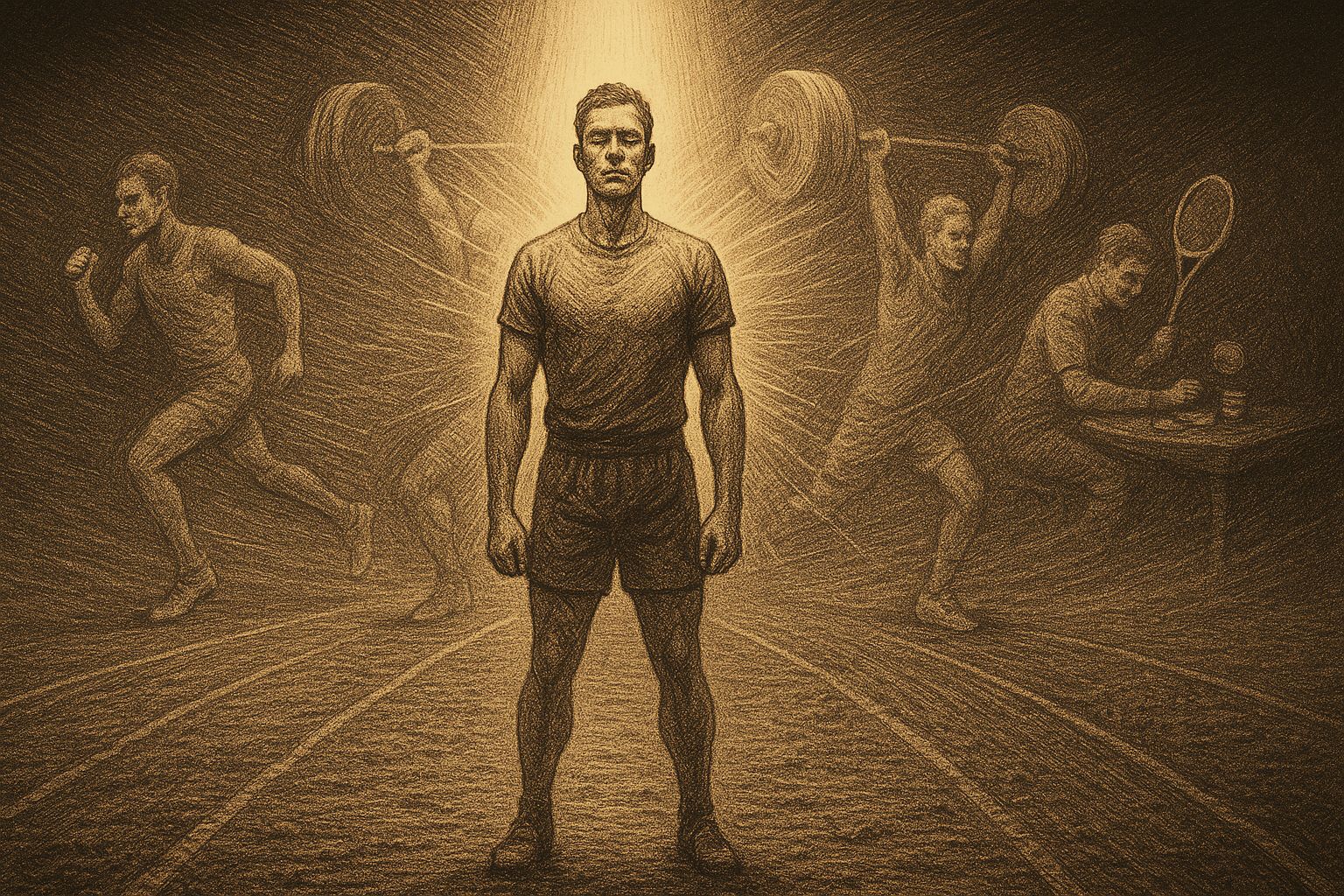
There’s a part of me that only wakes up when I’m competing. It doesn’t matter whether it’s running, poker, powerlifting, or more recently padel. There’s a quiet electricity that fills my body. A kind of alertness that isn’t forced or manufactured. It’s just there. Waiting.
On Friday morning, before my first group match of Bali’s biggest padel tournament, I felt it instantly. I opened my eyes and could feel energy moving through my chest, my stomach, my whole body. Not anxious energy, but something cleaner. Something alive.
I remember walking onto the court and thinking, almost laughing to myself, I live for this shit. In that moment nothing else mattered. Not winning. Not how I looked. Just the experience of showing up fully to something that asked for my best. That feeling of being wide awake and completely in the moment is rare in everyday life. Competition brings it out of me every time.
The First Arena I Ever Stepped Into
My relationship with competition started long before I understood what I was really chasing. When I joined my local running club at eleven, competition became the place where I tried to earn my worth. Every race felt like a chance to be seen. Every good result felt like a moment where I mattered a little more.
The roots might not have been healthy, but the behaviours it created were. Running taught me discipline. It showed me what slow progress feels like. It taught me that if you show up consistently, things change, even when the improvements are almost invisible day to day. Before races I’d feel that familiar silence on the track. The nerves. The pressure. And underneath it, a quiet desire to prove something.
Looking back now, I still wonder what I was really competing for. Was I trying to grow? Or was I trying to feel like I was enough? Probably both. But those years shaped the part of me that comes alive when the stakes rise. And they set the tone for everything that came next.
Competing With the Mind
When poker arrived in my life at twenty-three, competition took on a completely different form. Suddenly it wasn’t my body on the line, it was my mind. Every decision, every bluff, every tiny mistake felt like a reflection of whether I was smart enough to win. In its own way, it became another arena where I tried to earn my worth.
But poker also gave me something running never did. It taught me how to learn. It taught me structure, analysis, patience, and how to obsess over the smallest details. It required a different kind of discipline, one built around clarity, focus, and emotional control. And weirdly, I loved that challenge. I loved feeling like my whole mind had to be at its best.
When I eventually stepped away from poker at twenty-nine, I felt a strange emptiness I couldn’t explain. I didn’t miss the hours or the grind. I missed having something to compete in. Something that asked for my best. Something that pushed me to stretch my limits. Looking back, that was the first time I realised competition wasn’t just a thing I did. It was a part of who I was.
Finding a New Arena
After stepping away from poker, I slipped into a period where I didn’t quite know what to do with myself. I was still training, still moving my body, but nothing felt like it had a real edge to it. That changed when I found strength training. At first I was just competing with myself in the gym, adding a little more weight, refining technique, trying to become stronger week by week.
But eventually something in me wanted more. I wanted the pressure. I wanted the test. I wanted to stand on a platform and see what I was capable of when it counted. Competing against others felt like the natural next step, not because I wanted to beat anyone, but because the presence of rivals has a way of pulling out parts of you that never surface on your own. Some people avoid that. I’ve always moved toward it.
And then came padel. What started as something fun I did with friends quickly became something I cared about. I trained more. I worked with coaches. I paid attention to the details. I wanted to understand the game on a deeper level. Yesterday at the padel tournament, I felt all of that build-up reach a tipping point. We won two of our three group matches, but the match we lost taught me the most. At 6–6 in the super tiebreak, I made three unforced errors, not because I lacked the skill, but because in that moment I stopped trusting myself.
Competition reveals you like nothing else. It shows the progress you’ve made. It shows the cracks still left to close. And somehow, even in the sting of those moments, I find myself loving the process more. Not for the outcome. But for who I become as I chase it.
As I reflect, I’ve realised I’ve had three key insights about competition — insights that have shaped how I understand it today.
Insight #1: Competition is a Mirror
One thing competition does better than anything else is reflect the truth back to you. Not the surface-level version of yourself you show in training, but who you are when the moment asks for your best. Pressure strips away the performances, the stories, the illusions. What’s left is real. What’s left is you.
I’ve noticed that when the stakes rise, old patterns come to the surface. The hesitation. The desire to control. The places where trust is still shaky. These things stay hidden in everyday life, but competition brings them forward with brutal clarity. It collapses all the noise and leaves you face-to-face with the parts of yourself you still haven’t fully grown into.
That honesty is uncomfortable at times, but it’s also invaluable. Training builds the skill. Competition reveals the gaps. It shows you where you’re solid and where you’re still holding back. And once you’ve seen those things clearly, you have something real to work with. Something grounded. Something true.
Insight #2: Competition can’t give you self-worth
The second thing I’ve learned is that competition becomes dangerous the moment it becomes a way to earn self-worth. When I was younger, I didn’t see the difference. If I ran well, I felt valued. If I played well in poker, I felt intelligent. If I lifted well, I felt strong. Every performance became a quiet attempt to prove something about who I was.
The story underneath it was always the same. If I win, I matter a little more. If I lose, something in me is lacking. It took years to see how much pressure that creates. You stop competing freely. You start gripping tightly. Every mistake feels personal. Every setback feels like a statement about your identity.
But competition was never the problem. The story was. When worth gets tied to outcomes, the whole experience becomes heavy. You start needing the win instead of wanting to grow from it. And that’s when competition stops being a place of expression and becomes a place of fear.
I’ve found a lot of peace in separating the two. World number one golfer Scottie Scheffler recently said that winning tournaments gives a sense of accomplishment, but it doesn’t bring fulfillment. That line stuck with me. Fulfillment doesn’t come from results. It never can. Competition can push you, challenge you, and wake you up, but it can’t complete you.
The moment you stop asking it to fill something inside you, everything becomes lighter. You can give your best without needing anything in return. You can play freely. You can lose without losing yourself. And you can win without the illusion that it makes you more than you already are.
Insight #3: Competition is a catalyst
The third insight is the one that feels truest for me now. I don’t love competition because of the outcome. I don’t love it for the rankings, the trophies, or the recognition. I love it because of who I become when I’m preparing for it. Competition is the catalyst. It is the thing that makes me train harder, focus deeper, and stretch myself further than I would if there were nothing on the line.
When I know I’m stepping into an arena, I sharpen. I pay attention to the details. I push through the sessions I would otherwise skip. I look honestly at my weaknesses. I refine the edges of my game. The real growth never happens on competition day. It happens in the hundreds of quiet hours leading up to it. Competition gives those hours direction. It turns effort into intention.
On the day itself, what I love most isn’t winning. It’s the feeling of being all-in. Fully present. Fully alive. There is something about giving your best with no guarantee of the outcome. Something honest about standing in a moment that asks for everything you have and responding without hesitation. In those moments, I feel connected to myself in a way everyday life rarely accesses.
Competition at its best is almost a spiritual experience disguised as a sport. It forces presence. It sharpens self-trust. It strips away the noise and asks you to meet the moment as you are. And when you do, something inside you expands. The result becomes almost irrelevant. The real victory is showing up fully.
That is why I keep coming back. Not for the proof. Not for the validation. But for the aliveness. The feeling of being fully here, giving my best effort to the moment and accepting anything that comes after.
The Limits of Competition
The last thing I’ve learned is that competition, for all the energy and clarity it brings, has its limits. It can wake you up. It can sharpen you. It can push you to grow. But it cannot fulfil you. It cannot give you your worth. And it cannot answer the deeper questions we carry inside.
I’ve stopped expecting it to. I used to believe that winning would finally make me feel complete, like I had arrived somewhere meaningful. But the feeling never lasted. The high would fade. The next challenge would appear. And the old stories about worth would start quietly rebuilding themselves. It took a long time to understand that fulfillment doesn’t live on podiums or scoreboards.
What competition does give me, though, is something I value just as much. It brings me alive. It pulls me fully into the present moment. It gives me a place to express who I already am, not a place to become someone new. It offers connection to myself, to the moment, to the act of giving everything I have without holding back.
That’s all I really want from it now. Not validation. Not even victory, though I still love to win. Just the experience of showing up fully. The chance to feel that quiet electricity again. To stand in an arena that asks for my best and to meet it with presence.
Competition doesn’t give me my worth. It just gives me a place to express it.
And that, for me, is the real gift.
Adam