- Exploring The Inner Game with Adam Carmichael
- Posts
- Padel, Pressure and the Performance Lessons I Didn’t Expect
Padel, Pressure and the Performance Lessons I Didn’t Expect

Adam Carmichael
November 25, 2025
This weekend I played a three-day padel event, and it ended up teaching me more about myself than I ever expected. I went into it thinking it would be fun, competitive, and a good test of where my game is at. But what actually unfolded was far more personal and revealing.
On Friday, I felt incredible. There was a buzzing energy running through my body, not anxiety, but aliveness. The kind of energy that reminds you you’re doing something that matters to you. Something that wakes up a deeper part of you. I felt present, sharp, and genuinely excited to compete. It’s been a long time since something made me feel that way. I was able to perform close to my best and we made it through a tough group to get to the knockout rounds.
Saturday was a test of a different kind. My first match had around 30–50 people watching, most of whom I knew, and it was the most nervous I’ve felt in years. But I handled it well. I settled my breathing, found my rhythm, and we won 6–1. I walked off the court proud of myself. I felt like I had shown up as the version of me I want to be: composed, competitive and able to perform under pressure.
But then things took a turn.
Saturday night I couldn’t sleep at all. Too much adrenaline, too much excitement, too much pressure I was placing on myself. I started thinking ahead to Sunday’s quarter-final and convincing myself we could win the whole tournament. Instead of resting, my mind was spiralling. By the time I woke up on Sunday, I already felt off. The best way I can describe it is I felt disconnected from my body. Not myself and too in my head.
When I stepped onto the court, everything hit me at once.
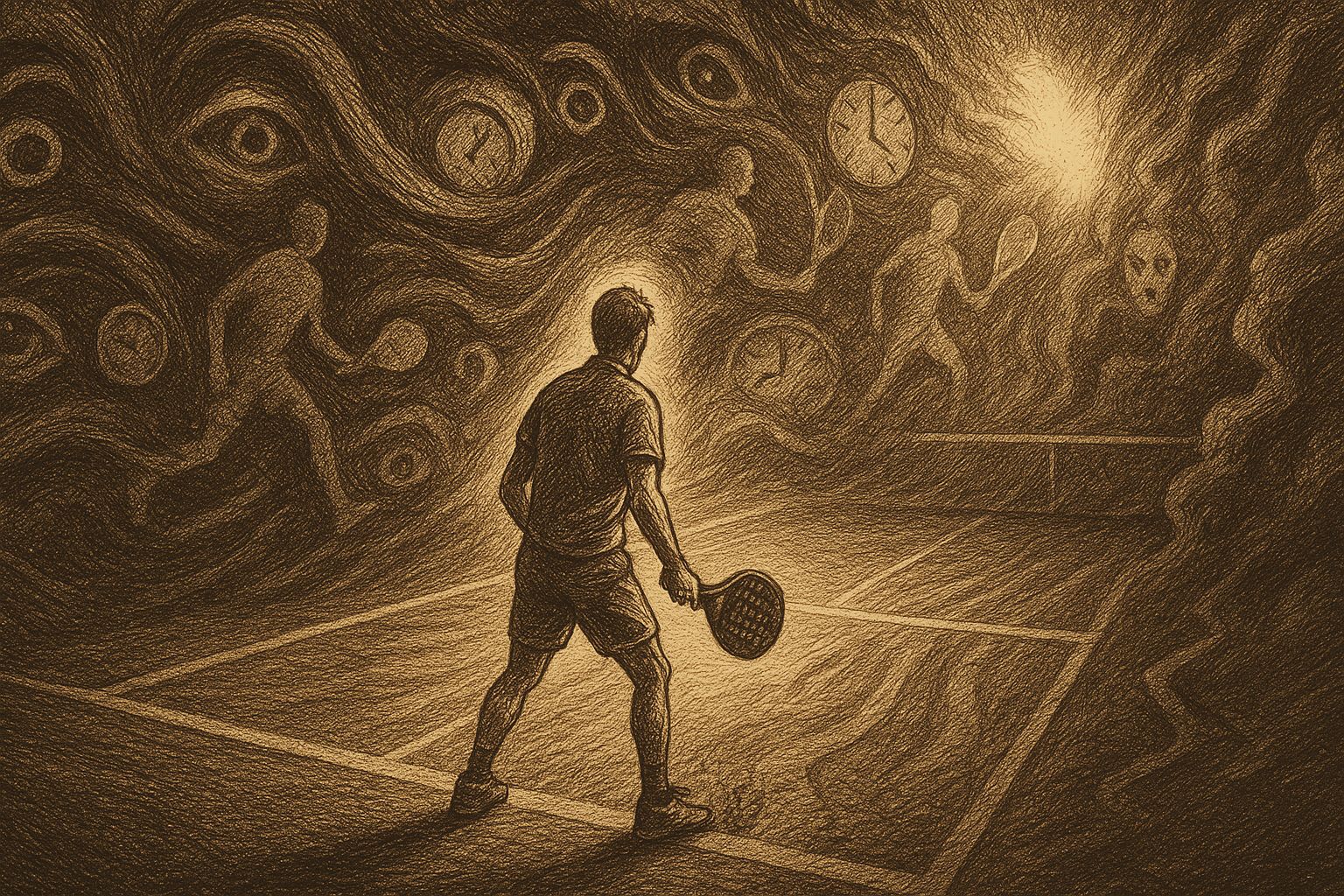
I felt overwhelmed in a way I haven’t felt in years. My mind wasn’t functioning the way it normally does. My thoughts were fast and scattered. My body felt tense. There were periods where I didn’t know what I was actually trying to do. I started to make sloppy mistakes and I lost trust in myself to figure things out. It was like I couldn’t access the calm, composed version of myself I’ve spent years building. Instead, I felt fear. And I didn’t know how to get out of it. When I was serving, I could feel myself almost shaking. I could feel my partner looking at me, waiting for me to lock in. I could feel the other players watching. I could feel the expectations I had built in my own head. And inside, there was this sinking feeling:
“Why am I crumbling? I’m supposed to be good at handling pressure. I literally coach people on this.”
The shame hit hard.
Not shame about the mistakes. Not shame about losing. But shame about the fact that my mind wasn’t there. Shame that I couldn’t access the tools that usually come so naturally to me. Shame that I care so much about being the calm competitor — and on the biggest stage so far, I wasn’t.
After the match, I felt disappointed, frustrated, and honestly a bit embarrassed. I walked away feeling like I had let myself down. And my partner. If I played my normal game, we would’ve won comfortably. Part of me wanted to pretend I didn’t care, but I did. I cared a lot. And that’s what made it hurt more.
After sitting with everything for a couple of days, I’m still not entirely sure what to make of it. Part of me keeps replaying those moments on the court, trying to understand what actually happened inside me. Another part of me is trying to see the bigger picture. Not in a neat, “everything makes sense now” way, but in a more honest way where I’m simply observing myself.
What I keep coming back to is this feeling that the experience wasn’t just a loss or a bad performance. It felt more like a mirror being held up to parts of myself I haven’t looked at in a long time. It made me aware of where my nervous system really is, how easily my identity can still attach itself to an outcome, how my self-worth can subtly tangle itself with performance, and how much work I still have to do in those moments when pressure exposes all the cracks.
I also realised something else: I haven’t competed in a truly high-pressure, physically public environment for years. Poker brings its own intensity, but no one is watching your body, your movements, your expressions, your energy. There’s no crowd. No eyes on you. No physical stakes in the same way. What happened on Sunday felt different. More visceral. More exposed. More immediate. I couldn’t hide from it. I couldn’t intellectualise my way out of it. It showed me a part of myself I haven’t placed under that kind of spotlight in a long time.
And as uncomfortable as it was, I can feel myself leaning into the idea that this might not be something to shy away from. Maybe it's something to explore. Maybe this is the beginning of something, of learning to thrive under a different type of pressure.
I don’t want to jump to conclusions, but I can feel a pull toward living more like an athlete again. I already do, but I want to lean into it even more. Not because I’m chasing trophies or wanting to prove anything, but because something in me comes alive when I’m training, improving, competing, and being stretched to step up. There’s a certain honesty that only pressure can reveal: the desire to grow, the hunger to get better, the fire that competition wakes up, the humility of being confronted by your limits, and the vulnerability that comes from caring deeply about something uncertain. I want more of that.
Padel, strangely, has become the first thing in a long time where I enjoy both the training and the performance. I love learning new shots. I love the repetition of drilling. I love the strategy, the physicality, the small improvements no one else sees. And I love the version of myself that starts to emerge when I commit to it properly. Showing myself I can learn a new skill and compete at a decent level.
But this weekend also reminded me of what competing at a high level actually demands. It’s not about playing well in a game with friends. It’s about navigating the moments when your mind stops cooperating. When the old patterns come rushing back. When your identity gets stirred up by expectation and fear. When you are making mistakes and you feel like everyone is watching and judging you. It’s about learning to stay calm and present when it really matters.
So yes, I felt shame. I felt disappointment. I felt embarrassed. Those emotions were real and strong.
It shows me I have work to do. It shows me I am not as free from expectations and pressure as I thought I was. It shows me that I can still get caught in my minds narratives and care too much. All of this is an opportunity for growth.
I feel like I experienced the best and worst of myself this weekend. On one side I can see the part of myself I want to be bring out more, the calm competitor who can have fun and perform when it matters. On the other side is the part of me I want to outgrow, the version that gets overwhelmed by pressure and let’s himself down.
I’m glad that I went through this experience. I’m glad that I’ve exposed my weaknesses. I’m glad that it hurts as it shows that the fire is still burning. I’m a big believer that Pain + Reflection = Growth.
I’ve felt the pain, I’ve done the reflecting, now it’s time to grow.
Next chapter pending…
Adam