- Exploring The Inner Game with Adam Carmichael
- Posts
- How I’m Re-Engineering My Environment for Deep Work
How I’m Re-Engineering My Environment for Deep Work

Adam Carmichael
November 08, 2025
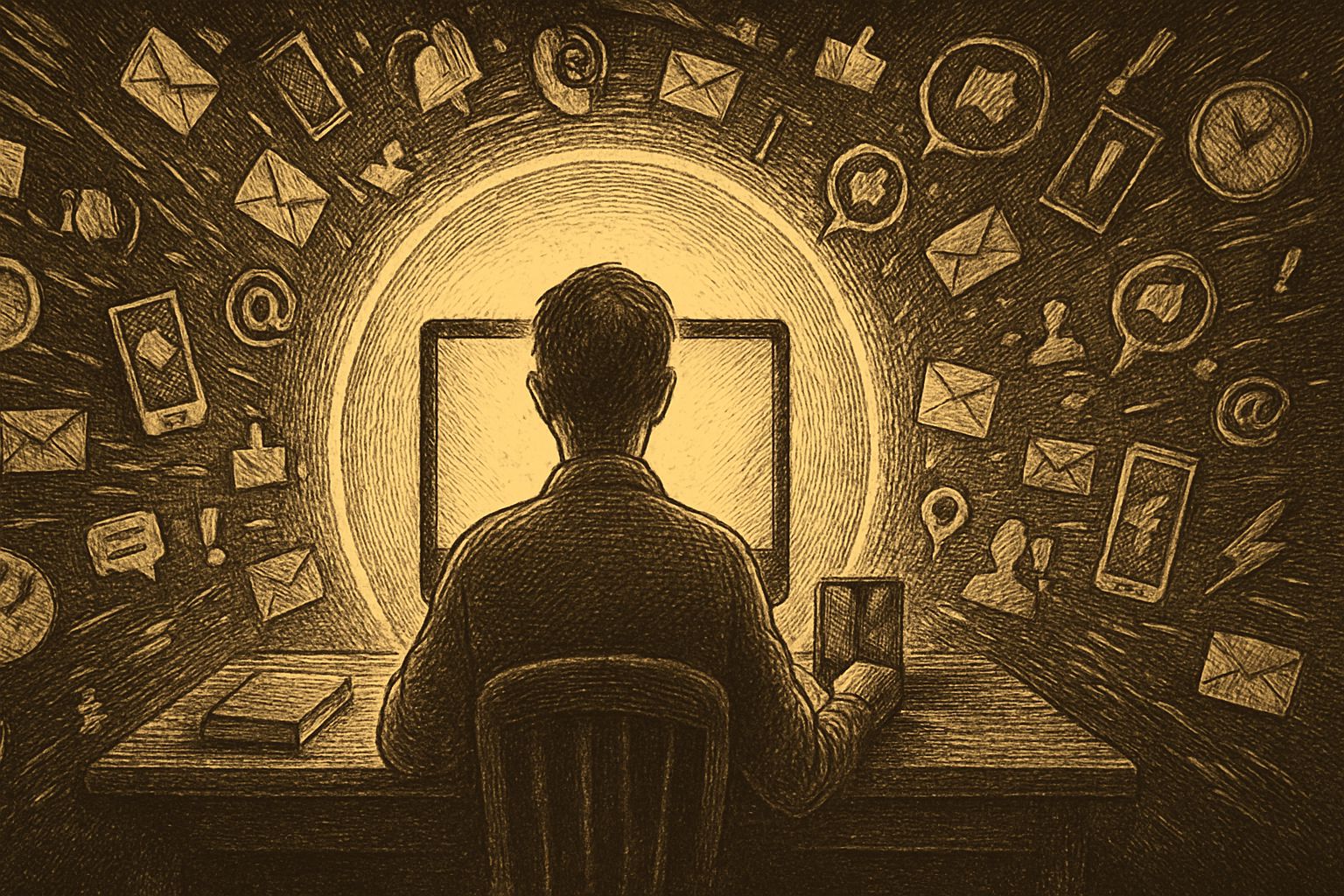
Distraction and stimulation are the default. You have to design for focus and peace.
It’s easy to underestimate how difficult it has become to do deep work. We live in an environment that constantly pulls our attention in a thousand directions. Every app, every notification, every small red bubble on a screen is competing for a moment of our focus. And when you multiply those moments over the course of a day, it becomes obvious why so many of us struggle to sit still, to think clearly, or to sustain focus on one meaningful task for more than a few minutes.
For a long time, I believed I could overcome distraction through discipline. If I could just be more focused, more structured, more in control, I could get back to that state of flow that I knew was possible. But the more I tried to fight distraction with willpower, the more I realised how limited that approach was. Willpower is a finite resource. The mind eventually tires and you give into your environment. I’ve learned that focus is not something you fight for, it is something you design for. You don’t overcome distraction through resistance, you remove it through structure.
The First Battle: Designing for Focus
One of the biggest challenges I have been facing while writing my book is that my writing station is also my work station. I sit down with the intention of writing, but within minutes my mind finds reasons to do something else. I check emails, I respond to Discord messages, I tinker with some small piece of work that feels productive but isn’t what I truly set out to do. Sometimes I start researching a concept that sparks my curiosity and before I know it, I’ve fallen down a rabbit hole for an hour, convincing myself it’s “part of the process.” But it isn’t. It’s avoidance disguised as productivity.
When I reflect on it, the problem isn’t motivation. It’s design. The space I’m using is telling my brain that multiple things happen here — writing, work, communication, planning — so naturally, my mind behaves accordingly. To focus deeply, the environment has to communicate one clear message. It needs to tell the body and the mind, “This is where writing happens. Nothing else.”
So that’s my next step. To create a single-purpose space used only for writing. A place where there is nothing to do but sit, think, and create. I’ll block off the hours from seven to ten in the morning, use FocusMe to restrict internet access apart from a few research tabs, and build a ritual around that time. I already know that once I sit down in that space, the resistance will fall away. Focus doesn’t have to feel forced when the environment is aligned with your intention. It becomes the natural state.
The Second Battle: Designing for Peace
The second challenge has been less about work and more about rest. Over the past few months, I’ve noticed a quiet slacking of standards around my evenings. For years I’ve been an early riser. I love waking up at five, when the world is still asleep and the air feels fresh. Those quiet hours have always been my most creative, and I’ve built much of my best work from that space of solitude and stillness. But recently I’ve been waking later, not because I want to, but because I’m going to bed too late.
The reason is simple: stimulation.
After nine at night, when the day is done and my mind is tired, I find myself reaching for my phone. I tell myself I’m just going to check the football results or scroll for a few minutes, but an hour later I’m still there. Reading news that doesn’t matter. Consuming fragments of information that add nothing to my life. It’s not just wasted time, it’s stolen presence.
What’s ironic is that I used to have this problem solved. My old phone was set up to become a “dumb phone” after eight o’clock. The screen turned grey, the apps locked, and if I wanted to open anything, a small message would pop up: “Are you sure you want to continue?” It was a tiny moment of friction, but it changed everything. It gave me just enough space to pause, to realise what I was doing, and to choose differently.
When I upgraded my phone, I didn’t reapply those settings. I told myself I would be fine without them, that I had the discipline by now. But I didn’t. Within a few weeks, I fell straight back into the same late-night loop. And it reminded me of a truth I keep relearning: if you don’t design your environment intentionally, you lose by default.
So this week, I’m setting up my new phone properly. I’ll use an app called Freedom to lock me out completely after eight. No exceptions. No manual overrides. I want to create a barrier that stops me from chasing dopamine hits in my weakest moments.
What’s Currently Working Well
A few systems are still serving me well, and they remind me that the smallest acts of design can have the biggest impact. I keep my phone on airplane mode before bed and for at least the first hour after I wake up. Often, I don’t turn it back on until midday. People who know me well now understand that I don’t reply to messages until the afternoon, and I rarely miss anything important. Those morning hours are mine. They are quiet, still, and undisturbed. I can read, write, reflect, or simply sit with my thoughts before the noise of the world begins to seep in.
Another small but powerful change I made a while ago was installing DFTube, a Chrome extension that turns YouTube into a blank white screen with nothing but a search bar. No recommendations, no thumbnails, no algorithm waiting to hijack my curiosity. If I want to watch something, I have to know what I’m looking for. It’s a gentle but profound shift. It replaces impulse with intention.
All of these tools have one thing in common — they remove friction from the things that matter, and they add friction to the things that don’t. The result isn’t restriction, it’s freedom.
Design Beats Discipline
I have begun to accept that focus and peace are not rewards you earn through willpower. They are environments you build through design. It’s tempting to believe that if we just tried harder, if we were more disciplined or more motivated, we would finally have control over our attention. But the truth is, the environment always wins.
As Atomic Habits author James Clear says, "I'm yet to see someone stick to good habits in a bad environment".
If you live surrounded by noise, you will absorb it. Or waste valuable energy trying to block it out. That’s what I’m realising as I continue writing this book. The quality of my attention is directly proportional to the quality of my environment. There is a paradox here that I keep coming back to: focus doesn’t come from forcing attention, it comes from creating space with intention.
The more I design my environment for focus, the less I have to force myself to concentrate.
So this is the reminder I’m sitting with this week: you don’t fight distraction, you out design it.
And if you read this far, maybe that’s a question worth asking yourself too:
What would your environment look like if it was designed for focus, not distraction?
Adam